

How to Help With Science Fair Projects (Without Doing It for Them)
 October 28, 2026
-
 6 Min
Support, Structure, and Good Questions — and Let Your Child Own the Work
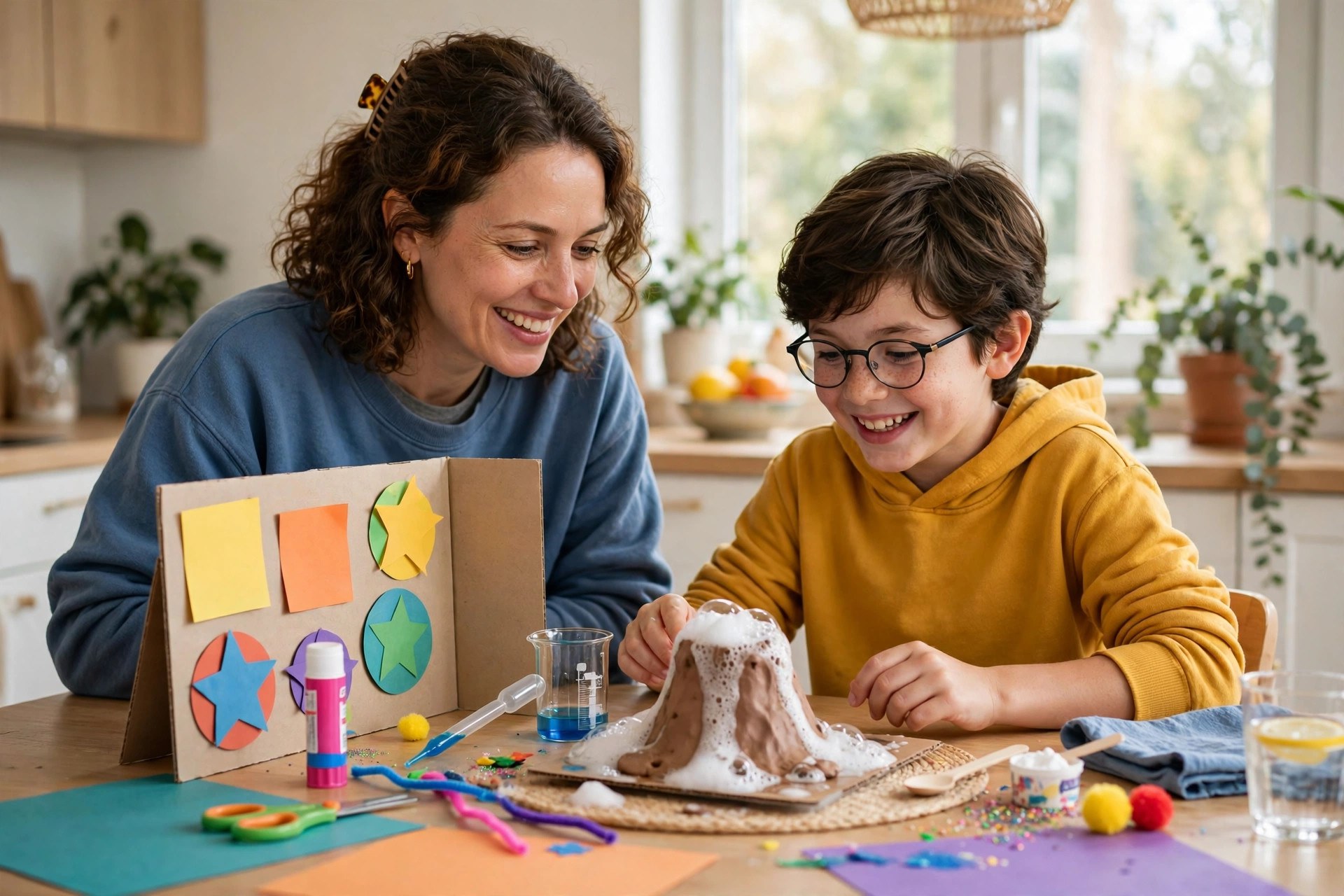
The science fair handout comes home, and suddenly the kitchen table is covered in poster board, glue sticks, and a project that feels much bigger than your child expected. Every parent faces the same temptation: just take over, tidy it up, and get it done. Resist it. The learning — asking a question, testing it, and explaining what happened — is the whole point. Your job is not to be the scientist. It is to be the coach and the calendar that keeps the project moving.
1. Start with your child's question, not yours
The best projects start with something your child is genuinely curious about: which paper airplane flies farthest, what keeps ice from melting longest, or whether plants really grow toward light. Instead, ask questions that narrow their idea down: "What do you wonder about that?" and "What could you actually test at home?" A good science fair question can be answered with a fair test, where only one thing changes at a time. "Do plants like music?" is too vague. "Do bean plants grow taller with classical music or with no music, when everything else stays the same?" is a project.
2. Plan backwards from the due date
Most science fair stress is not about science at all — it is about time. Sit down together as soon as the handout arrives and work backwards from the due date. Put the experiment, the results, the written report, and the display board on the calendar as separate jobs, with the board last, not first. A simple rule that saves many families: the experiment should be finished at least a week before the project is due,. If your child's teacher gave a rubric listing the required sections — question, hypothesis, materials, procedure, results, and conclusion — keep it visible and check each section off. That sheet is your best guide to what the teacher is actually marking.
3. Be the assistant, not the scientist
There is a clear line between helping and taking over, and it is easier to hold if you agree on roles up front. Your child is the scientist: they choose the question, make the prediction, run the trials, and write up what happened, in their own words and at their own level. You are the assistant: you drive to the dollar store for poster board, you help measure safely, you read a draft and ask "Can you explain this part to me?" — and you step back when they can do a step themselves. If a step is genuinely unsafe or needs an adult, such as using a stove or a sharp tool, you handle that part and say so plainly.
4. Let the messy middle happen
Here is the part parents find hardest: the experiment will probably go wrong at least once. The seeds will not sprout, the volcano will fizz too early, or the results will show no difference at all. That is not a failed project — that is science. Help your child write down exactly what happened, including the surprise, and ask what they would change if they ran it again. A conclusion that says "My prediction was wrong, and here is why" earns far more credit than a perfect-looking result nobody can explain. Repeat trials matter too: one trial is a story, three trials are evidence. If your child is frustrated, take a break, not over.
5. Keep the display board simple and readable
A good board is not the fanciest board — it is the clearest one. Help your child lay out the sections in order, left to right: question and prediction, materials and steps, results with a simple chart or table, and conclusion. Big headings, short sentences, and one clear chart beat walls of small text every time. Let your child do the writing and the gluing, even if the letters are not perfectly straight. If you are tempted to retype the whole board the night before the fair, ask yourself who the board is for. A slightly crooked board your child can explain with confidence beats a flawless board they are afraid to talk about.
6. Practise the talk, not just the board
On fair day, your child will need to explain the project out loud, often to an adult they have never met. That is where many strong projects lose marks. Practise at home with three simple prompts: "What was your question?", "What did you do?", and "What did you find out?" Let your child answer in their own words, not from a memorized script. Then ask one follow-up question they might not expect, such as "What would you do differently next time?" so a surprise question does not freeze them on the day. Two short run-throughs, praised for clear explanations rather than perfect delivery, build more confidence than anxious rehearsals the night before.
7. How tutoring can help
If your child is stuck on the science itself — turning a vague idea into a testable question, organizing results into a chart, or writing a conclusion that actually matches the data — a little outside help can unstick the project without taking it over. An Ontario-certified teacher can walk your child through the scientific method step by step, check that the experiment is fair, and help them explain their findings in clear, simple language. That is the same support we offer in Math and English sessions, one-on-one or in small groups, online or in person in Brampton — and a free trial session is a good way to see whether it helps.
A science fair project done this way takes a little longer and looks a little less perfect — and it teaches far more. Your child learns to ask a question, test it honestly, and stand beside the results, even when they are surprising. That confidence is worth more than any ribbon, and it is exactly what they will carry into their next project, and the one after that.
Try a Free Session
The best way to see if tutoring is right for your child is to try it. Book a free trial session with one of our Ontario-certified teachers — online or in person in Brampton — and get an honest sense of where your child stands and what would help most.
Prefer to talk first? Call (647) 624-8393 or message us on WhatsApp.